Jersey Astronomy Club
  • News and Events
  • How to Find us
  • Photography Competition
  • Contacts and Forms
  • Gallery
  • Newsletters
  • History of the Club

Visit of Beaver Colony to Astronomy Club

26/2/2015

1 Comment

 
Beavering Away

Monday night saw a visit by 1st (St. Ouen) Beavers to the astronomy club. Before they went into the club house, the planets Jupiter and Venus were pointed out to them, shining brightly in the night sky.

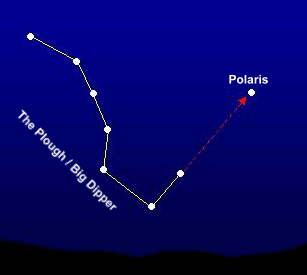
A brief presentation was given about different aspects of astronomy, looking at telescopes, the moon, stars, galaxies, comets, constellations, how to find the North Star. Samples of meteorites were also handed round for the children to see and touch.

A game was played with identifying and lining up large blow-up planets, and the second half looked at the difference between stars and planets and ended with a lively quiz.

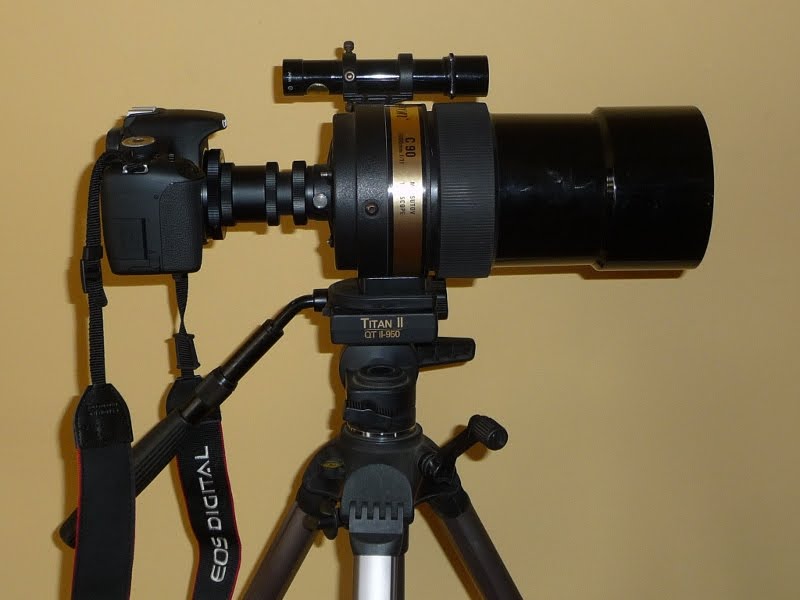
Despite the cloudy skies, a telescope set up outside did manage to show some of the Beavers glimpses of the moon closer up.
1 Comment

The Wonders of Islamic Astronomy: Samarkand Observatory

24/2/2015

0 Comments

 
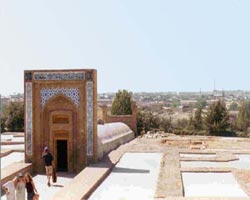
The Ulugh Beg Observatory is an observatory in Samarkand, Uzbekistan. Built in the 1420s by the Timurid astronomer Ulugh Beg, it is considered by scholars to have been one of the finest observatories in the Islamic world.

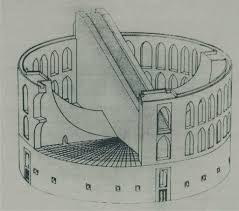
Only part of the sextant and the foundation of the Ulugh Beg Observatory in Samarkand have been preserved. The location of this observatory was discovered in 1908, when Russian archaeologist Viatken discovered an endowment document that stated the observatory's exact location.

Ulugh Beg was been assassinated in 1449, by religious extremists. Ulugh Beg's observatory  was also destroyed by religious fanatics in 1449.

As Heather Hobden notes:

“The library of 15,000 books was looted, and the scholars driven out of Samarkand. The religious leaders declared the hill on which the observatory had stood, was the burial place of ‘forty maidens’. They built a mausoleum to these ‘forty maidens’ on this site and turned it into a lucrative centre for pilgrimage, hoping by this means to utterly destroy the memory of the observatory”

But parts of the site remained despite this. While working at the excavation site, Viatken found one of the most important astronomical instruments used at the observatory: a large arch that had been used to determine midday.

The archaeological findings also showed that the building was cylindrical in shape, with an elaborate, well-designed interior. Using the dome of the observatory, astronomers developed the Ulugh Beg Tables, which are considered one of the most accurate astronomical tables in the world.

The dome had inscriptions that marked the degrees, minutes, seconds, and tenths of a second of the epicycles, the seven planets, and the fixed stars, as well as the earth and its regions, mountains, and deserts.

Among the astronomers who worked at this observatory was Ghiyath Ad-Din Al-Khashi, who excelled in mechanical modeling of celestial movement.

The discoveries and research conducted at Ulugh Beg Observatory were very important at the time as astronomers could predict eclipses and calculate the hour of the rising sun and altitude of a celestial body, and meant their hypothesis of a stellar year was rather accurate, at 365 days, 6 hours, 10 minutes and 8 seconds, only about 1 minute longer than the modern electronic calculations!


0 Comments

Capella- The Star that is more than one Star!

11/2/2015

0 Comments

 
Picture
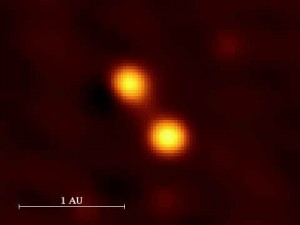
Double star system Capella. Image Credit: Atlas of the Universe
Capella is the brightest star in the constellation Auriga, the sixth brightest in the night sky and the third brightest in the northern celestial hemisphere, after Arcturus and Vega. Its name is derived from the diminutive of the Latin capra "goat", hence "little goat". 

Capella is the brightest star that is the same yellow colour as the sun. It is the brightest yellow star in our sky visible to the naked eye, and is about 42 light years away.

But did you know.... 

Although it appears to be a single star to the naked eye, it is actually a star system of four stars in two binary pairs. The first pair consists of two bright, large type-G giant stars, both with a radius around 10 times that of the Sun and two and a half times its mass, in close orbit around each other.

The second pair, around 10,000 astronomical units from the first, consists of two faint, small and relatively cool red dwarfs.


0 Comments

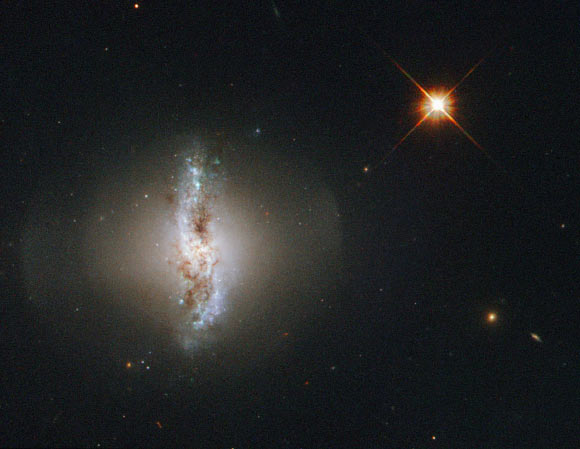
Arp 230: A Cosmic Clash of Cymbals

5/2/2015

0 Comments

 
Picture
Image Credit: ESA/Hubble & NASA (Acknowledgement: Flickr User, Det58)
Some galaxies gave relatively orderly shapes, but others like Arp 230 feature the Dr. Halton ‘s “Atlas of Peculiar Galaxies”

Halton Christian "Chip" Arp (March 21, 1927 – December 28, 2013) was an American astronomer. He was known for his 1966 Atlas of Peculiar Galaxies, which (it was later realized) catalogues many examples of interacting and merging galaxies.

Arp realized that astronomers understood little about how galaxies change over time, which led him to work on this project. This atlas was intended to provide images that would give astronomers data from which they could study the evolution of galaxies.

Based on its citation by other astronomers, Arp's atlas is recognized now as an excellent compilation of interacting and merging galaxies. Many objects in the atlas are primarily referred to by their Arp number.

Arp 230 is one such galaxy, a 80 million light-years away in the constellation Cetus.  It is isolated with no nearby dwarfs or companions. It has the mass of nearly 9 billion suns and can be seen above in infrared and optical wavelengths by Hubble.

The peculiar shape of the galaxy strongly suggests that it is the result of a head-on collision between two spiral galaxies.

That collision would have taken place approximately 100 million years ago. This was the middle of Cretaceous Period on earth, when Tyrannosaurus Rex was roaming the earth.

The collision would have led to a burst of star formation which is now fading or over. Its appearance now suggests that it is slowly becoming an elliptical galaxy, providing evidence that elliptical galaxies are the result of mergers.

0 Comments

New Channel Islands Astrophotography Group

2/2/2015

0 Comments

 
Picture
I'm delighted to announce Jean Dean has started a new Facebook group for the Channel Islands on Astrophotography.

Channel Islands Astrophotography Group
https://www.facebook.com/groups/channelislandsastrphotography

An informal group for Channel Islanders to show their astrophotography images and share their skills with members. Everyone is welcome to join from beginners to advanced, DSLR or CCD. Also a place to advertise your astronomy equipment as you upgrade, so hopefully it will be a good place for beginners to pick up good quality second hand equipment. 

Other Channel Island Facebook Groups

SAstroS (Sark Astronomy Society)
https://www.facebook.com/groups/SarkAstronomySociety


The Astronomical Society of the Channel Island of Guernsey
https://www.facebook.com/AstronomyGuernsey

And of course our very own
Jersey Astronomy Club
https://www.facebook.com/JerseyAstronomyClub


Remember that our own website here also has a gallery, and welcomes any views of the night sky from the Channel Islands.


0 Comments

    Webmaster

    Tony Bellows

    Archives

    January 2025
    April 2024
    April 2023
    October 2022
    August 2021
    October 2020
    June 2019
    January 2019
    June 2018
    March 2018
    December 2017
    September 2017
    August 2017
    May 2017
    March 2017
    January 2017
    December 2016
    November 2016
    October 2016
    September 2016
    August 2016
    July 2016
    May 2016
    April 2016
    March 2016
    January 2016
    December 2015
    September 2015
    August 2015
    July 2015
    June 2015
    May 2015
    April 2015
    March 2015
    February 2015
    January 2015
    December 2014
    November 2014
    October 2014

    Categories

    All

    RSS Feed

Powered by Create your own unique website with customizable templates.